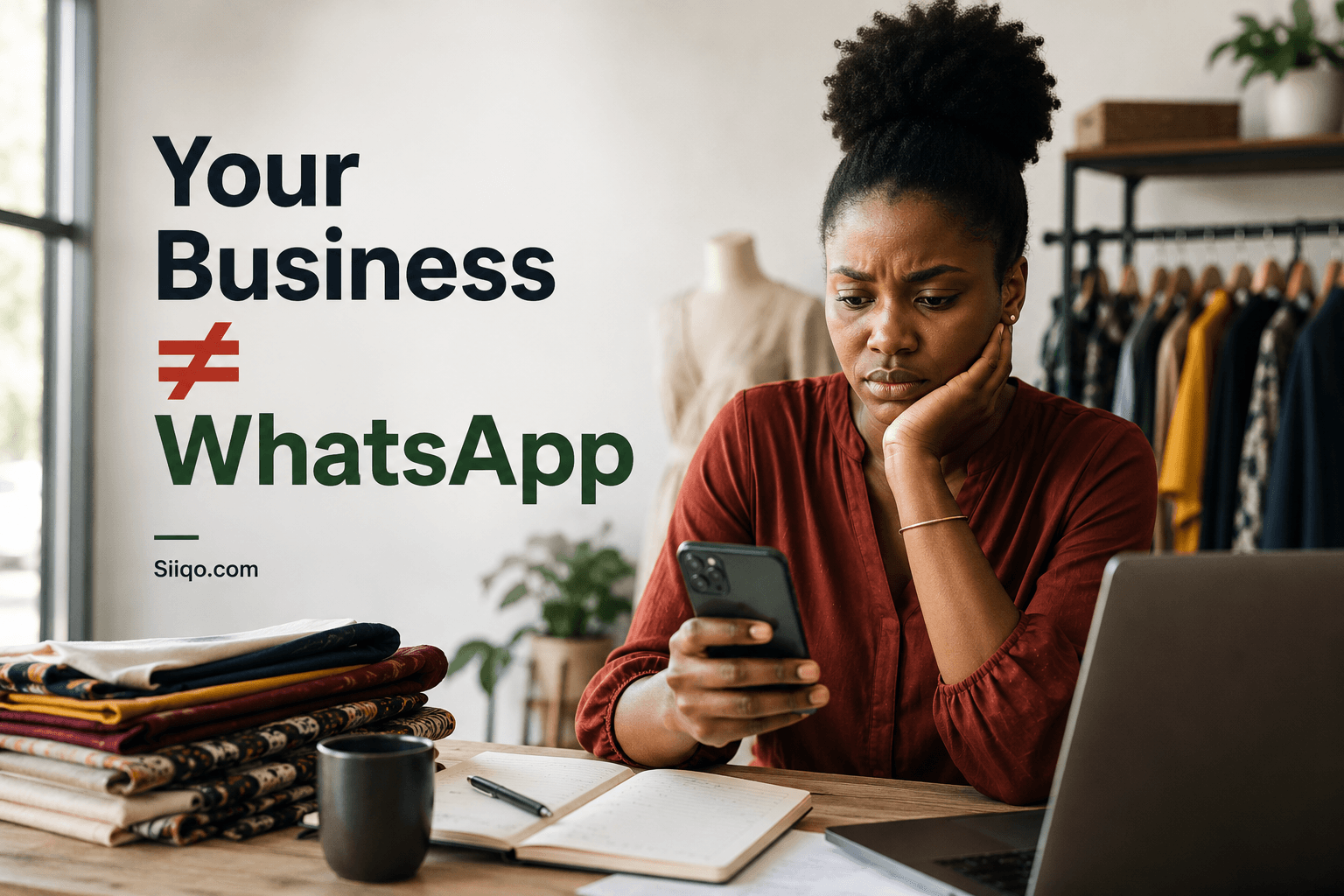
Why "My Business Is on WhatsApp" Isn't a Business Model
Ask ten Nigerian entrepreneurs where their business lives, and eight of them will describe a phone number. Not a name. Not a place. A number, saved under a business name in a few hundred contact lists, holding together everything they've built.
For a long time, that was fine. It was more than fine — it was smart. WhatsApp is free, it's where the customers already are, and it turned a spare room and a sewing machine into a functioning shop faster than any website ever could. Nobody should feel foolish for having started there. Almost everyone did.
But there's a quiet confusion sitting underneath that success, and it's worth naming plainly: a WhatsApp number is not a brand. It's a channel. And a business that only exists inside a channel it doesn't own is renting its entire existence from a landlord who owes it nothing.
Just How Deep This Goes
This isn't a fringe habit among a few disorganised traders. It's the default operating system for Nigerian small business. Over 91% of Nigerian SMEs run mainly on WhatsApp for commerce and customer interaction, according to research shared by digital strategist Banke Ajayi and reported by Nigerian tech outlet LabarinTech — and WhatsApp itself sits at over 95% penetration among Nigerian internet users, per Statista figures cited across multiple market reports. That's not a niche behaviour. That's most of the country's small business economy sitting on a single, third-party chat app.
Sit with that number for a moment, because it explains a lot about why this conversation matters right now. When something is used by nearly everyone, it stops looking like a choice and starts looking like infrastructure — something as neutral and permanent as electricity or a phone network. But WhatsApp isn't infrastructure in that sense. It's a product, owned by one company, that can and does change its own rules on its own schedule. Every business owner treating it as bedrock is building on something that was never designed to be load-bearing for an entire economy of small sellers.
And it has already gone dark before, all at once, for everyone. In October 2021, Facebook, Instagram, WhatsApp, and Messenger went offline together for roughly six hours — a single company's internal network error taking down every major channel millions of businesses depended on, worldwide, at the same time, with zero warning. Nigerian vendors who relied on WhatsApp status updates to announce new stock, Instagram DMs to close sales, and Facebook Marketplace listings to get discovered lost all three at once, for the better part of a working day. Nobody got a refund for the sales that didn't happen. Nobody could appeal to anyone. The lights just came back on, eventually, on Meta's timeline, not theirs.
That's the risk hiding underneath convenience. Not that WhatsApp is badly built — it isn't — but that a business with no presence outside it has no floor under it either.
And WhatsApp is not even the only rented room in this picture — it's simply the most crowded one. The same Nigerian sellers who depend entirely on a WhatsApp number often layer a second dependency on top of it: an Instagram or TikTok account whose reach is decided by an algorithm nobody outside Meta or ByteDance can see or influence. A page that reached ten thousand people last month can reach eight hundred this month for reasons that are never explained and rarely reversible by anything the seller did or didn't do. None of that is a reason to abandon those platforms either — they're genuinely useful for discovery. It's a reason to notice the pattern: almost every tool a Nigerian small business uses to reach its customers is owned by someone else, governed by rules the business has no vote in, and capable of changing overnight. The only asset in that entire stack that belongs entirely to the business owner is the name, the storefront, and the customer list built underneath all of it — which is exactly why those three things deserve to be built first, not last.
The Difference Between Being Findable and Being Remembered
Here's a small test. Think of a business you've bought from more than once on WhatsApp. Now try to describe it to a friend without pulling out your phone. Can you spell the name? Do you know what it's actually called, or only what it looks like in your chat list — a first name, an emoji, a blurry logo thumbnail?
Now do the same exercise for a brand you know from anywhere else — a shop, a label, a name you've seen on packaging or a receipt or a billboard. You can say it out loud. You can tell someone else where to find it without handing them your phone.
That gap is the whole argument. A WhatsApp seller is discoverable only to people who already have the number. A brand is discoverable by anyone who's heard the name. One of those things can grow by referral alone, slowly, one saved contact at a time. The other can be searched for, shared, screenshotted, and found again months later by someone who forgot everything except that it existed.
This is not a small distinction dressed up as a big one. It's the difference between a hustle and a company. A hustle answers messages. A company gets found.
What You're Actually Selling, and Why It Needs a Home
Every serious business in fashion, beauty, food, or design in Nigeria right now is selling more than a product. It's selling a feeling — status, taste, belonging, the sense of being someone who knows where the good things are before everyone else does. That's not a criticism. It's how identity-driven categories have always worked, from tailors to perfumers to the person who always seems to know the best small chop spot in town before it gets crowded.
Think about what actually happens when someone buys the "right" pair of sneakers, the "right" perfume oil, the "right" aso-ebi fabric for a wedding they weren't even that close to the couple for. They're not just acquiring an object. They're purchasing entry into a version of themselves — the one who's current, the one who's put-together, the one other people quietly look to for a cue on what's good. That's ego, in the technical, non-insulting sense of the word: the part of a person that wants to be seen a certain way. It is one of the oldest and most reliable engines in commerce, and Nigerian consumer culture runs on it as visibly as almost anywhere in the world — from owambe fashion to the quiet flex of a well-chosen fragrance.
But a feeling like that needs a place to live that feels intentional. A verified storefront with your name on it, consistent photography, real reviews, a link that looks like it belongs to something — that's a home for the feeling you're selling. A WhatsApp chat thread, no matter how good your product photos are, will never carry that weight the same way. It looks like exactly what it is: a conversation, not a destination. Customers can feel the difference, even when they can't articulate it. It shows up as hesitation before they pay, or as the quiet decision to go with the vendor whose page looked a little more "real," a little more like something other people already trust.
The businesses at the top of any Nigerian retail category right now — the ones with waiting lists, the ones people namedrop unprompted at a party — didn't get there by being the easiest to message. They got there by being the easiest to remember, and remembering requires something more permanent than a chat thread that resets every time someone clears their phone storage.
The Dependency You Don't Notice Until It Costs You
There's a second problem with building entirely inside WhatsApp, and it's less about branding and more about control.
Every rule of that channel — who can message whom, how many messages are allowed before it looks like spam, what gets a number restricted or banned outright, what starts costing money and when — belongs to Meta, not to the seller. Nigerian businesses lose access to WhatsApp numbers regularly, sometimes with no warning and no real explanation, according to reporting from Nigerian tech press. When it happens, everything attached to that number goes with it: the customer list, the order history, the years of built-up trust, all of it locked behind an app that has no obligation to hand any of it back. A temporary restriction might clear in a day. A permanent ban doesn't come back at all, and there is often no meaningful appeal that actually restores the number.
Separately, Meta has also started reshaping how much it costs businesses to use its paid messaging tools. Starting in 2025, template messages on the WhatsApp Business Platform moved to per-message billing instead of a flat conversation fee. From October 2026, ordinary customer service replies on that same paid platform start costing money too, ending a free tier that had existed since late 2024. Most solo Nigerian sellers chatting directly from the free WhatsApp Business app on their phone aren't the ones this particular change bills — but it tells you everything about the direction things are moving. A platform this size adjusts its own economics on its own schedule, one message category at a time, for its own reasons, and every business built entirely inside it absorbs whatever comes next without a vote.
None of this is an argument against WhatsApp. It's an argument against depending on it completely. The two are different things, and conflating them is exactly how a hustle stalls out at the size a single phone number can carry.
There's a quieter cost to this dependency too, one that shows up less in headlines and more in missed opportunities. A grant committee, a corporate procurement officer, or a bank loan review process almost never accepts "message me on WhatsApp" as evidence that a business is real. They want a registered name, a track record they can verify, a professional presence that exists independently of a personal conversation. A seller who has spent three years building genuine trust with hundreds of individual customers over WhatsApp can still look, on paper, exactly like someone who started yesterday — because none of that trust is visible or verifiable outside the app it was built inside. That's not a failure of effort. It's a failure of infrastructure, and it's entirely fixable.
The Fake Alert Problem Nobody Budgets For
There's a third cost to running a business entirely on trust and screenshots, and it's the one that hits hardest because it's not hypothetical — it's happening to Nigerian sellers this month.
Digital payment fraud in Nigeria actually fell sharply in 2025, dropping 51% to ₦25.85 billion from ₦52.26 billion the year before, according to the Nigeria Inter-Bank Settlement System (NIBSS). That's genuinely good news, and it reflects real progress from banks and fintechs tightening their systems. But the same NIBSS data flags social engineering — tricking a person into believing a payment happened when it didn't — as one of the most persistent techniques fraudsters still use, and e-commerce and internet banking remain among the most exploited channels. For a merchant taking direct bank transfers over WhatsApp, that risk lands in a very specific, very familiar place: a fake alert screenshot, a doctored notification, a confident buyer who insists the money is "on its way" while walking off with the goods.
The structural problem is simple. A direct transfer gives a seller no protection between "the buyer says they've paid" and "the goods have left the seller's hands." Everything in between depends entirely on trust, a bank app refresh, and hoping the alert on the screen in front of you is real. For a seller doing one or two sales a day, that's a stressful, occasional risk. For a seller doing twenty, it's a mathematical certainty that eventually, one of those alerts is fake — and the loss lands entirely on the person who shipped first.
This is precisely the kind of risk that shouldn't be absorbed by trust alone, and it doesn't have to be. Payment held in escrow — where a buyer's money moves into a secure, third-party-held account the moment they pay, and only releases to the seller once delivery is confirmed — removes the fake alert problem from the transaction entirely. Nobody has to trust a screenshot, because nobody's money changes hands based on one.
What Owning Your Business Actually Looks Like: A Practical Build-Out
Owning a business, in the most literal sense, means the parts of it that matter can't be switched off by someone else's decision. That's not a mood or a mindset — it's a specific, buildable list, and most of it can be put in place in a single afternoon.
1. Claim a name, not just a number. Before anything else, decide what your business is actually called, register it if you haven't (a CAC business name registration in Nigeria costs a modest, budgetable fee and takes days, not months), and use that exact name everywhere — your storefront, your invoices, your packaging, your social bios. A name is the one asset that survives a lost phone, a banned account, and a platform migration, because it doesn't live inside any app at all. It lives in people's memory, which is the only server that never goes down.
2. Build a home your customer can visit without messaging you first. A dedicated storefront — a real, permanent link with your name on it — does something a chat thread structurally cannot: it lets someone browse, decide, and come back later without needing your number saved or a conversation still open. It's also the difference between a customer finding you through search, through a shared link, through a QR code on packaging, versus only ever finding you through someone else's forwarded contact. One of those grows on its own. The other only grows as fast as word of mouth travels.
3. Keep a record of your customers that lives outside any single app. Not because WhatsApp is untrustworthy — it isn't — but because no single channel should ever be the only copy of something this valuable. Who bought from you, what they bought, when, and how to reach them again: that list is arguably worth more than your current month's sales, because it's the foundation of every future month's sales. If it only exists as a scrollable chat history on one device, it isn't a customer database. It's a hope. Think about how differently a business owner could plan a restock, a promotion, or a loyalty offer if they could see, at a glance, who their repeat buyers are and what they tend to order — versus scrolling back through months of chats trying to remember who bought what. One is a growth strategy. The other is guesswork dressed up as memory.
4. Get paid in a way that doesn't depend on trust alone. Direct bank transfers expose both sides to fake alerts and reversed payments, as the fraud data above makes plain. Escrow-protected payment — money held safely until delivery is confirmed — takes that risk off the table entirely, for buyer and seller both, and it does something else worth noticing: it signals seriousness. A buyer who sees a verified badge and an escrow guarantee hesitates less, because the platform itself is vouching for the transaction, not just the seller's word.
5. Build a way to be found by someone who has never messaged you before. Referral only travels as far as an existing contact list reaches. Discovery — through search, through a local marketplace, through a link that gets shared because it's genuinely worth sharing — reaches the customer you don't have yet, the one who was never going to stumble onto your WhatsApp status because they don't have your number and never will, until the moment they find you some other way.
6. Keep WhatsApp — just stop making it the whole building. Nothing here argues for leaving WhatsApp. It remains one of the fastest, most personal ways to close a sale with someone who already knows you exist. The shift is subtle but total: WhatsApp becomes a door into the business, one of several, instead of being the business itself. A customer might discover you on a storefront, get their questions answered on WhatsApp, and pay through escrow — three different tools, each doing the one thing it's actually good at, none of them a single point of failure for the whole operation.
This is precisely the gap a platform like Siiqo exists to close for Nigerian sellers. A free, verified storefront at your own name — yourname.siiqo.com — gives a business the permanent home described in step two. Escrow-protected payments handle step four, so a buyer's money is never moving on trust and a screenshot alone. Hyperlocal discovery inside the Siiqo marketplace does the work described in step five, surfacing a business to buyers who were never going to find it through a saved contact. None of it asks a seller to abandon WhatsApp — it asks them to stop treating a phone number as the entire foundation of something that deserves a real one.
What that actually buys a seller isn't just protection from fraud or downtime, though it's that too. It's status. A verified badge, a clean storefront, real reviews stacking up under a business's own name — that's the same signal a customer reads off a boutique's shopfront, a designer's lookbook, a brand's polish. It tells a buyer, before a single message is exchanged, that this is a business worth trusting with money upfront. That's not a small thing in a market where the single biggest reason a sale doesn't happen is hesitation at the exact moment of payment. Building that trust once, into the storefront itself, does the selling a seller would otherwise have to do all over again in every single new conversation.
What This Looks Like Once It's Working
Picture the same fashion vendor two ways.
In the first version, she's on WhatsApp. New stock goes up on her status. A customer messages, asks for the price, asks if it's still available, sends a screenshot of a transfer, and she ships once she's checked her bank app and hoped the screenshot was real. If a stranger finds her, it's because someone else forwarded her number. If WhatsApp restricts her account next month over a spam report she didn't cause, her business effectively stops existing until — if — it comes back.
In the second version, the exact same clothes live on a storefront with her brand's name on it. A customer finds it through a friend's share, a search, a QR code on a delivery box from a previous order. They browse without needing to ask "do you have this in my size" first, because it's written on the page. They pay into escrow, so neither of them is trusting a screenshot. She still uses WhatsApp — for questions, for the personal touch Nigerian customers genuinely value — but it's no longer the only door into her business, and no single company's decision about her number can switch that business off.
Same products. Same woman. Same market. The difference is entirely in what she owns versus what she's borrowing, and it's the difference between a business that survives a bad month for one platform, and one that doesn't.
The pattern holds outside fashion too. A freelance graphic designer in Port Harcourt chasing clients through cold DMs and getting ghosted after delivering finished work looks completely different once invoices are branded, milestone payments sit in escrow before work even begins, and a portfolio lives somewhere a prospective client can review without first starting a conversation. A home baker in Abuja taking orders exclusively through WhatsApp status updates looks completely different once a customer three streets away can search for "small chops near me," find her storefront, see real reviews from people who ordered last month, and place an order without needing to know she exists beforehand. The category changes. The underlying fix doesn't.
The Real Shift
None of this requires abandoning WhatsApp, and nobody should. It requires recognising what it actually is: an excellent way to close a sale with someone who already knows you exist. It was never designed to be the reason they knew you existed in the first place, and it was never meant to be the only place your business's memory lives.
The entrepreneurs who build something that lasts in this market aren't the ones who left WhatsApp behind. They're the ones who stopped mistaking it for the whole business — who built a name, a home, and a record of their own, and let WhatsApp be one door into something bigger, instead of the entire building.
If that's the business you're actually trying to build — one with a name people remember, a home they can find on their own, and a way to get paid that doesn't depend on a screenshot being real — setting up a free, verified storefront on Siiqo takes a few minutes, and it's the one piece of this list that doesn't wait for a platform's decision to exist.
That's the difference between running a chat and building a brand. Only one of them survives a platform's bad day.
Frequently Asked Questions
Should I stop using WhatsApp for my business? No. WhatsApp is still one of the most effective ways to reach Nigerian customers directly, and nothing here argues for leaving it. The point is to stop treating it as the only place your business exists — build a storefront, a customer record, and a payment system that don't disappear if that one number ever does.
What's the real risk of running my whole business on WhatsApp? Three things, mainly: account bans or restrictions that can happen with little warning and no guaranteed recovery, platform-wide outages that take every channel down at once with no compensation for the sales lost, and payment fraud — specifically fake alert scams — that direct bank transfers leave entirely unprotected against.
How do I know if I should register my business before building a storefront? If you're selling consistently, register now rather than later. A registered business name in Nigeria is inexpensive and quick to obtain through the CAC's online portal, and it's what unlocks a proper business bank account, credibility with bigger clients, and eligibility for most SME grants and funding programmes.
Is it expensive to set up a storefront outside WhatsApp? Not necessarily. Platforms built specifically for Nigerian SMEs, including Siiqo, offer free storefronts with no listing fees, so the barrier to having a real, permanent home for your business is time, not money.
What's the single most important first step if I only do one thing from this guide? Separate your customer records from your phone. Whether that's a spreadsheet, a CRM, or the built-in customer list on a storefront platform, having a copy of who your customers are that doesn't live only inside one app is the one habit that protects everything else you build afterward. Everything else on this list — the storefront, the escrow protection, the discovery — compounds faster once that one habit is in place, because you're no longer rebuilding your customer relationships from memory every time something changes.